HT-28 Hellions
// Training Air Wing Five
HT-28 Hellions
// Training Air Wing Five


Squadron History
The Legacy of the "Hellions"
From VMF-218 to HT-28
Based at Naval Air Station Whiting Field, Helicopter Training Squadron TWENTY-EIGHT (HT-28) was established on May 25, 2007. While a modern squadron, the "Hellions" of HT-28 inherit a legacy deeply rooted in United States Marine Corps aviation, tracing their name and spirit back to Marine Fighter Squadron 218 (VMF-218) of World War II.
World War II: The Original Hellions
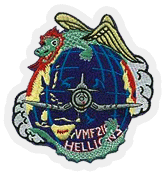
VMF-218 was commissioned on September 15, 1943, at Marine Corps Air Station Mojave, California, flying the Vought F4U Corsair. The squadron deployed to the Pacific theater in December 1943 and saw its first combat on February 15, 1944, providing air cover for the Allied landing on Green Island. During this time, VMF-218 was one of several Marine squadrons that had the unique distinction of allowing civilian contractor Charles Lindbergh to fly combat strikes against the Japanese garrison at Rabaul.
In November 1944, the Hellions relocated to Leyte to support the campaign to retake the Philippines. As part of Task Force 38, they conducted extensive operations, including strikes against Southern Luzon, air patrols over Leyte Gulf, and providing cover for convoys and ground forces across Mindoro, Cebu, and Mindanao. On March 10, 1945, the squadron supported the Allied landings at Zamboanga, which became their new base of operations for continued close air support and strike missions until the surrender of Japan in August.
Post-War Service and Transition
Following the war, VMF-218 spent a year in China, supporting the 1st Marine Division during the surrender of Japanese forces and providing security against Communist forces. The squadron was deactivated on December 31, 1949, as part of the post-war drawdown. Though it was briefly reactivated in the Marine Corps Reserve during the 1950s at NAS Willow Grove, Pennsylvania, the original Hellions squadron was ultimately disestablished on September 1, 1972, closing a chapter on its storied history.
Squadron Insignia: A Symbol of Heritage
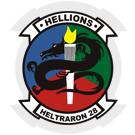
The HT-28 squadron insignia honors its joint-service mission and rich history. It consists of a tri-colored circular field, a dragon, and a torch.
- The Colors: The deep blue represents the U.S. Navy's global maritime operations, the olive green signifies the U.S. Marine Corps' projection of power ashore, and the red symbolizes a shared heritage of valor and sacrifice.
- The Dragon: A black Chinese "Loong" dragon, symbolizing wisdom and ferocity, is coiled around a lighted torch. Its helical shape is a nod to Leonardo da Vinci's early designs for rotary-wing flight.
- The Torch: The torch signifies the knowledge passed from one generation of aviators to the next.
- The Name: The "Hellions" name, while an allusion to the word "helicopter," also carries the amusing connotation of an "unruly child," referencing the student pilots as they are transformed and refined into skilled military aviators.